Showing posts with label IBM Notes. Show all posts

Thursday, 1 October 2015

IONET Archiver v4 - Improving your Native Notes Archiving

IONET Software are pleased to announce v4 of our Archiver for Notes product, which now includes support for native Notes archiving, even when it's already in use.

This means that for a big reduction on our normal pricing, you can use our archiving toolset with native Notes archiving.

Why would you want to do that? To make more efficient use of IT resources, find out what's happening in your environment, and - more importantly - save your users time.


What you get from Native Notes Archiving;
  • Fast, large-scale moving of data.
  • Easy management via Archiving Policies.
  • Support by IBM.

But what you DON'T get is decent tools to use that archived data, or even tools to tell you what's actually being archived. This means users spend a lot of time trying to find and use their archived data, and that can be improved.


What you can add with the IONET Native Archiving Toolkit;
(click images for a larger version)

   Simultaneous Searching across ALL Mail & Archive Databases via Notes, iNotes (including Mobile) or Browser. This makes it easy for users to find and use their data, regardless of its location.
    Discovery Search across all Mail & Archives, for Admins, Power Users, Legal Departments etc.
   The ability to natively archive Mail-In Databases.
   User Functionality like 'Archive Selected Documents', 'Restore Documents', and 'Open Archives'.
   Reporting and Charting of Archiving performance, e.g. Volume of data archived, Number of Docs archived, Production vs Archive Size Ratios etc.
   Tools to migrate local User Archives.
   Administration Tools such as ACL Synchronisation, limiting access to Archives, Archive Database naming, Archive Database moving etc.


What you miss out on by not using our full Archiving Solution;
  • Up to 10 Archiving Criteria, including folders, dates, document size, and @formulas.
  • Intelligent Quotas, e.g. gradually reducing databases sizes to the defined limit.
  • The ability to export data to different formats, e.g. HTML, XML and PST.
  • The use of Archive Stubs, to refer Notes and iNotes Clients to the archived document.
  • Two-stage archiving, e.g. archiving from archives.
  • Archive Housekeeping, such as automatic archive creation, rotation and expiry.
  • Archive Timing functions, so you don't over-run your archiving window.
  • The ability to archive duplicated mail documents.
  • The ability to compress attachments during archiving.
  • The ability to archive different documents to different databases, e.g. all documents in 'ACME' folders into the 'ACME Project' archive.
  • The ability to archive custom applications.
  • Flexibility options, e.g. protect certain documents, synchronise documents (such as lookup documents), set fields on documents during archiving, run custom agents before/after archiving and restoring, or before/after creating archives etc.

Key Features;
  • Allows Users to easily find and use natively archived data, via Notes or iNotes, saving them time.
  • Allows Administrators to manage the archiving environment, performing common tasks and migrating local archives.
  • Gives Management visibility to archiving effectiveness via Reporting.
  • Allows native archiving of Mail-In Databases.
  • Adds Discovery Search functionality to your Mail & Archive environment.
  • Builds on Native Archiving functionality.
  • Blends seamlessly into your Notes/Domino environment.


To find out more, please visit our Native Archiving Toolkit Page.

Monday, 22 June 2015

Exporting Notes Mail, Applications & Quickr to XML

Earlier this month, our Archiver for Notes product was extended to export Notes Mail, Applications and Quickr to HTML, in addition to exporting Notes Mail to Internet Formats and PST, and normal NSF archiving.

Exporting to HTML occurs via archiving to DXL, then transforming that DXL to HTML via XSLT Stylesheets. This allows storage of Notes data as static, non-proprietary HTML.

This process now
extends further to transform DXL to XML, ready for use in other products. Example XSLT Stylesheets to do this are stored as Pages, and you can modify these or add your own.

This means you can export some parts of your Notes environment (e.g. Mail) to common internet formats or PST, other elements (e.g. old applications, IBM Quickr) to HTML, and  specific newer elements (e.g. application data less than 5 years old) to XML for migration to other platforms.


The process is;

1. Select your target data, export method and stylesheet.


2. Stylesheets are stored as Pages in the Archiver Config database, so you can use these, customise them, or add your own.


3. Notes data is then exported to the target XML.


You can choose to leave the Notes data intact after exporting, meaning you can run the process as many times as you want.

For more information or a free, no-obligation trial version, please see the IONET Archiver for Notes.

Monday, 8 June 2015

Archiving from Notes to HTML

Since March, it's been possible to use our Notes Archiving tool to archive Notes Mail to Internet Formats and PST, as well as perform normal Notes (to NSF) archiving.

We've now added the ability to archive Notes Mail and Applications to HTML and DXL/XML as well.

This allows Administrators to easily target specific Notes data, then process it based on their requirements, e.g. archiving to Notes itself, storing it in a non-proprietary format like HTML or XML, or migrating it for use with another application.


For example, to migrate to Outlook;

1. Your first archive criteria might first remove all mail with the phrase '[SPAM]' in the Subject.
2. Your second criteria might then archive all historical mail over 5 years old, and without the phrase '[HR]' in the Subject, to read-only HTML.
3. Your third criteria might then archive all mail 1-4 years old to PSTs named "Username" Notes Mail 2011 - 2014.
4. Your fourth criteria might archive all mail less than 1 year old to PSTs named "Username" Notes Mail 2015.

OR;

1. Archive all mail over 1 month old to PSTs named "Username" Notes Mail, leaving the original mail intact. This can be done over time without users even being aware of it, in order to migrate the majority of user data (as mail doesn't tend to change too much after the first month).
2. At a designated cutover date, archive any changes plus the remaining data, resulting in all Notes Mail being available in PSTs.

OR you could;

1. Select custom Notes applications and archive all data over 6 years old to HTML.
2. Archive all remaining data to DXL/XML, transform it via XSLT, and use it in another application.


There are multiple customisation options, and you can modify our stylesheets to suit your own processing requirements.


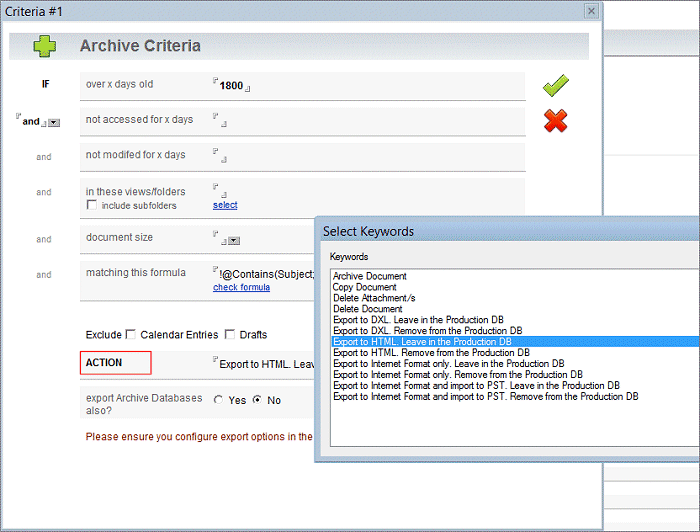
1. Select Archive Criteria (or you can just archive the entire database).


2. Exported Mail Results in HTML.

3. Exported Application Results in HTML.


4. Exported Mail Results in PST.


For more information or a free, no-obligation trial version, please see the IONET Archiver for Notes.

Friday, 24 April 2015

Removing the clutter: De-duplicating Mail Search results

In general, mail files contain a lot of duplicated data, due to the 'Reply With History' function. 

So if you search for a phrase in the first email of a thread, you'll probably receive results from ALL the other emails in the thread as well, which clogs up the result set and makes it harder to find your target.

The IONET FT Search Manager now optionally allows users to de-duplicate mail results, displaying only the latest entry in the thread, containing all information from the rest of the thread.

This makes it much easier to find target data, as you don't have to wade through a lot of very similar, repeated results. Of course you can still search normally if you're looking for a specific email.

Without De-Duplication


With De-Duplication


You can also use our 'Navigate to Query' option to automatically move to the first instance of the search term used, which speeds up the target identification process.

And seeing as email is person-person communication, specifying a name in the query (or a domain name) increases search accuracy significantly.


Try it out free of charge and with no obligation, and we think you'll be surprised at the results.

The IONET FT Search Manager - Targeted Notes searching

Tuesday, 24 June 2014

Our version of the IBM Mail Next 'Faceted Search'

In a recent webcast, IBM demonstrated several aspects of the search capabilities in IBM Mail Next. 

Once of these was 'faceted search', which allows users to choose elements of the result set (facets) and refine their query using that data.

To show how our search product, the FT Search Manager, can also provide faceted searching, we've put together the short video below (the other Mail Next search functionality mentioned, searching Sametime Chats Transcripts, we can already do).

Please note that in our product you can construct search results using any combinations of fields, text and @formulas. In all cases, the tool will correctly identify the type of result data (text, mail address, date, number etc), and allow you to select facets based on that. For example, an Email address will let you choose the sender or domain, a Date will let you choose various timeframes around the selected date, a Number will let you add margins to the selected number etc. And this works for any application you search, not just Mail.

To try this yourself, please download the no-obligation, no-install demo from http://www.ionetsoftware.com/search, and start searching.

FTSM V6 Faceted Search Demo


Wednesday, 30 April 2014

Searching Sametime Chat Transcripts

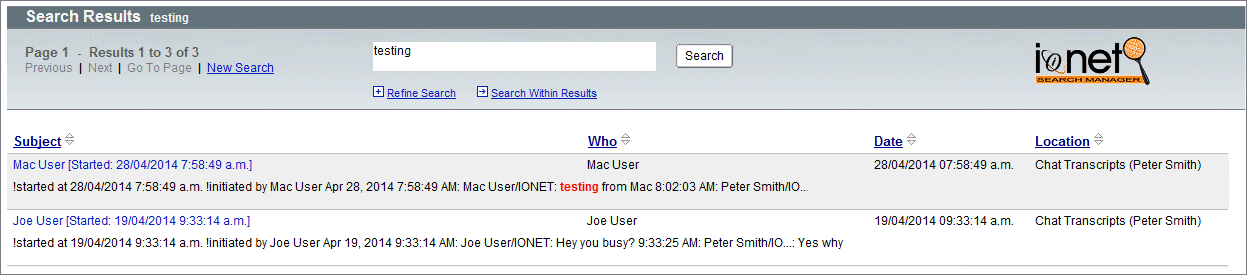
To further extend our FT Search Manager product, we've added the ability to index and search local Sametime Chat Transcripts.

This means users can search their Mail, Archives, Chats, Applications and File Systems, at the same time, from anywhere in the Notes Client.

And they don't need to do anything - if they have chats on their PC, they'll be automatically available for searching.

To try it out yourself, just download a demo from http://www.ionetsoftware.com/search.


Search Interface


Results


For any other types of Notes searching, please visit http://www.ionetsoftware.com/search.
 

Monday, 17 March 2014

Adding Search Options to iNotes Mobile Search

To complete our iNotes Mobile Search product - giving mobile users full access to all of their historical mail data - we've added user search options.

Administrators can still default and/or hide whatever settings they want, but this allows users more control over their mobile search environment.

This makes it even easier for them to find any mail (including archives) when on the road.


1. Mobile Home (with new Search icon)


2. Search Interface


3. Search Options


4. Searching


5. Results


For more information, please visit http://www.ionetsoftware.com/inotes.

Thursday, 5 December 2013

New features in the FT Search Manager

Over the past month we've added some new features to the FT Search Manager. These are;

1. Attachment Name searching.
Which allows you to search attachment names within documents, not possible with standard Notes searching. For example, you can search on strings like "Budget 2014", wildcards like '*.xls', or multiple operators like 'xls OR pdf'. You can also combine those queries with normal queries, e.g. to find all PDFs sent to acme.com in the last 3 months. This functionality also applies to Discovery/Compliance searching.


2. Navigate to Query
The ability to automatically navigate to the first query word when opening results. 


3. New default 'Result Processing' options. 
Each customer can update this functionality to their own requirements.


4. Shared Mail support
The ability to automatically make Shared Mail databases available for searching, either to all users in the ACL, or specific users.


For more information, or demo software, please visit http://www.ionetsoftware.com/search.


Next, we'll add new functionality for iNotes mobile searching, installed automatically;

1. iNotes Home (note the new Search Icon)


2. Search Interface


3. Searching


4. Results

Wednesday, 28 August 2013

Improving user efficiency in a Notes environment

Earlier this month, we ran a survey with our FT Search Manager users.

We asked them how much time, per employee per week, they thought the FT Search Manager was saving them.

The average answer was 1 hour 23 minutes per person, per week. That equates to a saving of 8.3 days per person, per year, as described by the users themselves.

Note that we restricted the survey results to 'general' searching only, e.g. Mail/Archive & Application searching, because companies using the FT Search Manager for Discovery/Compliance searching have specialised search requirements, saving even more time, as shown below in the Appendix.

Saving each user over 8 days per year is a huge efficiency improvement. And because the FT Search Manager has a once-only, per-user price between $3 - $13 per user (depending on volume), it's also a fantastic ROI.


Example
A company with 1000 users implements the FT Search Manager, with a total product cost (once-only), of $7750. After 1 year, they've saved 66,400 hours, or 8300 days.

That's the equivalent of adding another 33 employees. And at an average US salary of $48,000*, well over $1,000,000 in potential productivity gains.

And the great thing is, the same gains are made year after year.


This is achieved because more efficient search tools make much better use of your existing data. In this case it's our search tool, but it could be any.

For more information, demonstrations, or to set up a trial, please visit http://www.ionetsoftware.com/search.


* source: http://www.ofm.wa.gov/trends/economy/fig102.asp


Appendix: Specialist Searching
Survey responses received from companies using the FT Search Manager for Discovery/Compliance/Specialist searching;

"Well FT Search Manager is now an absolute 'must' for XXX. Because of the volume of data we have to split it across multiple databases. And what the users are searching for is the number of times a particular device failure for a specified device from a particular manufacturer has happened in the last n months. The results will be in a minimum of 2 Notes databases - active and relatively recently completed investigations. ......So they use it every day, a lot. Anything up to 40 people use it to process 250 - 300 reports a week. If it saves them 5 minutes per report then that would be up to 1500 minutes a week."

"It can save between 20 minutes a week to many hours. It is most useful as an administrator when I get asked to perform a legal discovery search where I can search for a string of words in a date range in 3000 odd email archives. I could not do this previously."

"For us, it's about how much time it saves each time we get an open records (Discovery) request. In the past it would take often several hours per request (about 4 requests per month). Now it takes a maximum of 30 minutes per request. The other benefit is that the search is consistent across mailboxes and the criteria can be printed for future reference."

"Our Legal department request me to do a search over a number of user's databases (incl archived mail ) and export all data to an external harddisk. I have done this several times and I could not have done this without the FT Search tool."

"What it did do at the time when we used it was save us 100's of man hours sifting through mail files and collating that into results"

Wednesday, 21 August 2013

Searching Within Results in the Notes Client

The latest version of the FT Search Manager allows you to 'Search Within Results' in the Notes Client.

This means that when searching your Mail & Archives, Applications, or performing Discovery/Compliance searching, you can search within the result set multiple times, and also back out each step (e.g. to change a search term, correct a typo etc).

Refining a search in this way makes it a lot easier to find target information.


 For example, a search of Mail & Archives for 'IBM', initially returns 2404 results;


 Then Search Within Results for 'partner*';


 Total now = 1492 results


 Search Within Results again for 'PWCS' (total now = 34 results) 


 Search Within Results again for 'signed' (total now = 9 results) 


 Search Within Results again for 'PSWWUA' (it's the wrong spelling, so no results) 


Therefore back out 1 level via the "Undo Search Within Results", to get back to the 'Signed' query (9 results). Note you can keep backing out the Search Within Results until you're back to your original query.


 Now Search Within Results again on the correct term 'PWSWUA' (total = 3 results) 


Proximity Operator
We've also added a NEAR proximity operator, which can be more accurate than AND.

 For example, a search for Mark AND Partner returns 90 results; 


 whereas a search for Mark NEAR Partner returns only 8 results; 


 'NEAR' is defined as being within 10 words, but you can also define that yourself, e.g. to 20 words


 You can also combine the NEAR operator with Search Within Results;


To try it yourself, please just download from http://www.ionetsoftware.com/search.

Monday, 15 April 2013

'Discovery-style' searching for Notes users

During the upgrade to R9, we extended our File Indexer to automatically index the content of ZIP files (the File Indexer is an extension to the FT Search Manager, and allows you to index & search doc, docx, xls, xlsx, ppt, pptx, odt, odp, ods, pdf, vsd, wpd, txt, htm and html files on your local PC or server-based File Systems. More information can be found here). 

In addition, the FT Search Manager itself now allows you to select and copy File System results to another location, or attach them to a Notes database.

This makes 'discovery-style' searching for users much easier, because they can search their local PC at the same time as Mail & Archives, find all relevant data (either in email or files), then 'process' it, e.g. copy it elsewhere, perhaps in response to a litigation request.

Shown below are the default processing options - you can easily customise or add your own.


1. Search (Notes Client)


2. Select Results (Notes Client).
Note this OpenOffice document is within a ZIP file on the c: drive, yet you can see the contents quite easily.


3. Define ZIP handling.


4. Define File handling.


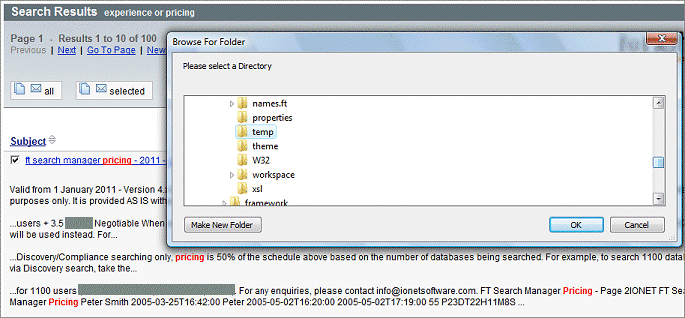
5. Specify File System copy location.


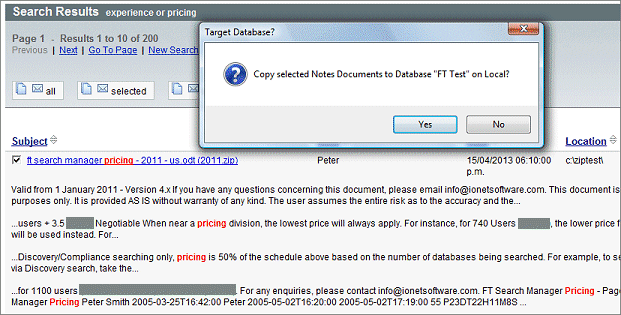
6. Specify Notes data copy location.


7. Processing Complete.


For more information, please visit the FT Search Manager page.