Monday, 13 May 2013

Searching Applications & File Systems directly from the Notes Client

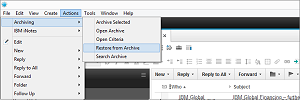
New functionality in the R9 Notes Client has finally allowed us to integrate our search tool properly into the Notes Search List, via Widget, as below;

You could for example search your Notes Applications & Application Suites, server-based File Systems, and Quickr, all at the same time and directly from Notes. You can then add your Mail, Mail Archives, and local PC files to the list. That's a quick way to search a lot of information, and therefore save a lot of time.

In addition, results come back with a lot more information than Notes usually provides, allowing easy target identification directly from the results themselves.


And as well as just searching, you can perform actions on the results, for example in response to litigation/information requests. Default actions including copying results to another location (Notes data into databases, Files to a selected Directory), but you can also customise these options and add your own handling.


The result is a comprehensive search tool for the Notes Client (and for Browsers, iNotes/DWA, and Web Services).

Aside from the plug-in, no other installation is required on the Client, and searching also works locally.

 
More information, demos and downloads are available on the FT Search Manager Page.

Monday, 15 April 2013

'Discovery-style' searching for Notes users

During the upgrade to R9, we extended our File Indexer to automatically index the content of ZIP files (the File Indexer is an extension to the FT Search Manager, and allows you to index & search doc, docx, xls, xlsx, ppt, pptx, odt, odp, ods, pdf, vsd, wpd, txt, htm and html files on your local PC or server-based File Systems. More information can be found here). 

In addition, the FT Search Manager itself now allows you to select and copy File System results to another location, or attach them to a Notes database.

This makes 'discovery-style' searching for users much easier, because they can search their local PC at the same time as Mail & Archives, find all relevant data (either in email or files), then 'process' it, e.g. copy it elsewhere, perhaps in response to a litigation request.

Shown below are the default processing options - you can easily customise or add your own.


1. Search (Notes Client)


2. Select Results (Notes Client).
Note this OpenOffice document is within a ZIP file on the c: drive, yet you can see the contents quite easily.


3. Define ZIP handling.


4. Define File handling.


5. Specify File System copy location.


6. Specify Notes data copy location.


7. Processing Complete.


For more information, please visit the FT Search Manager page.

Monday, 8 April 2013

R9 support for all IONET products

We're pleased to announce that all IONET products now support Notes/Domino R9 Social Edition.

The main updates are;

Change Manager (http://www.ionetsoftware.com/change
Support for all new R9 Directory fields & functions.

Notes Client
Browser (via User Reporting)

Demo video here.


FT Search Manager (http://www.ionetsoftware.com/search)
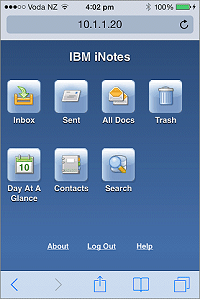
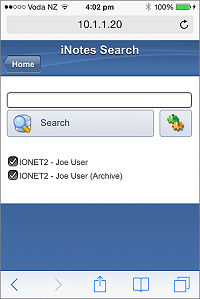
New optional CSS-based UI for the iNotes Social Edition (note new search bar).


Demo video here.


Archiver for Notes (http://www.ionetsoftware.com/archiving
New optional CSS-based UI for the iNotes Social Edition (note new search bar & menu items).

Demo videos here.


Thursday, 14 February 2013

Adding value to Lotus Notes

One of our partners asked recently how they could add value to Notes for their customers. 

To that end, we've put together the following brief guide of how we think our software can add value to Notes and save customers money.


1. Adding Value for Users


FT Search Manager


If every Notes user spends just 5 minutes a day (a reasonably conservative number) looking for information - say an email they sent a month ago, a phone number in a customer quote, or technical information contained in a PDF, that equates to 25 minutes per week, or about 20 hours a year.

That means that for an average annual salary of $44,000, that 5 minutes a day looking for information costs around $400/year, per user.

However giving users an effective search tool that allows them to find that information quickly and easily, costs around $10/year, per user (depending on user volumes).

Therefore an integrated search tool that allows each user to search their Mail, Archives, custom Notes Applications, Quickr, local File Systems and server-based File Systems - and all at the same time - pays itself off within about a week. The value added after that is huge.

For more information, demonstrations and downloads, please visit http://www.ionetsoftware.com/search.


Archiver for Notes


For maximum application efficiency, redundant data should be archived.

Archiving data from Lotus Notes applications (including Mail) adds value by increasing the application usability, speed, and effectiveness, while still making older data available if required (and without IT intervention).

This means the user is accessing the most current and most relevant data, but can still easily get to older data when required, including via the search methods mentioned above.

For more information, demonstrations and downloads, please visit http://www.ionetsoftware.com/archiving.


2. Adding Value for Administrators


Archiver for Notes


As above, archiving Lotus Notes applications increases their efficiency. Archiving also adds value for Administrators by increasing Backup/Restore efficiency, and managing data storage requirements in a smarter way.

The Archiver for Notes adds further value by performing all functions automatically, even to the extent of updating itself with new versions & bugfixes. This leaves Administrators more time for other tasks.

In addition, archiving is virtually transparent to users, resulting in less Service Desk calls.

For more information, demonstrations and downloads, please visit http://www.ionetsoftware.com/archiving.


Change Manager


In any IT environment, things change. In a native Domino environment, it's often impossible to know who changed what setting, when and why. The Change Manager for Domino adds value by actively enforcing Change Control in the environment, as well as by monitoring changes and providing regular audits.

This lets Administrators see what changed, who performed the change, and why.

As well as preventing possible problems (e.g. by setting incorrect values), the Change Manager also aids in problem resolution - by showing what recent changes could have caused a problem, or even if Domino was the problem cause at all (if nothing changed in Domino, perhaps the problem cause lies elsewhere).

For more information, demonstrations and downloads, please visit http://www.ionetsoftware.com/change.


3. Adding Value for Developers


Workflow Manager


Most custom Notes Applications all handle workflow differently. This is usually because they were developed by different developers, and/or at different times. The result is mostly hard-coded workflow, difficult and time-consuming to change.

The Workflow Manager provides a common, document-based workflow engine for Notes applications, implemented via a single-click.

This adds values for Developers by removing the need to develop and handle workflow individually per database, and provides a consistent, stable and professional workflow interface across all applications.

The result is faster deployment of new or modified applications, as well as providing other benefits such as cross-application Delegation and Approvers.

Users benefit also, because a consistent development approach means easier uptake of new applications.

For more information, demonstrations and downloads, please visit http://www.ionetsoftware.com/workflow.


Monday, 26 November 2012

FT Search Manager v5 - Full Notes Mail Integration

We're pleased to announce the availability of FT Search Manager v5, allowing full Notes Mail integration, as shown below. This integration can be implemented into the R853 Standard Client (Mail Files or Templates) via a single click, and provides yet another search method for Notes Clients, in addition to our existing Search Scope, Widget, Actions & Toolbar Icon search methods.

Minimised


Maximised
The UI is fully translatable (via documents, the Search button here is shown in German), and you can use your own logo, provide your own help functions etc. 

To try this in your own environment, please download a demo database here, then open the database and choose to set up Mail & Archive searching (for yourself or others), then select 'Set up searching via Mail File Integration'.


You can either just click the 'Install Mail Integration Search' button to install, or set it up manually following the instructions.

For more information about the FT Search Manager and other forms of searching, please visit the product page here.

Wednesday, 24 October 2012

Adding search highlighting to Notes documents

As part of a recent upgrade to our FT Search Manager product, we added a workaround/hack to offer (optional) search highlighting to Notes Mail documents.

For quite some time, this functionality has been 'available' in standard Notes Full Text searches, although it seems pretty hit and miss, and usually doesn't work with MIME content. As for the Agent property ''Store highlights in document", we've never found a way to use it (has anyone?)

So to add our own version, we used a Javascript handler on the result document to allow the search result HTML to call a LotusScript function. 

That function firstly backs up the target document, then converts MIME content to Rich Text, then parses the Rich Text using standard NotesRichTextNavigator, Range and Style techniques, adding word highlighting. It then saves the document and opens it, navigating to the first instance of a search phrase. Straight after loading the document, the code restores the original content of the document from the backup.

Hence the document loads with search results highlighted, but if you Reply With History or Forward (or re-open the document from mail), it uses the original document, as normal.

This function is only applied to mail search results, because;
a) mail doesn't generally get modified after delivery.        
b) there is limited chance of conflicts due to other users editing the document at the same time.
c) unread marks don't change.


This makes searching a lot more efficient, because you don't need to read the entire document looking for your target data, and you can use Ctrl-G to quickly move to the next instance of the search phrase.

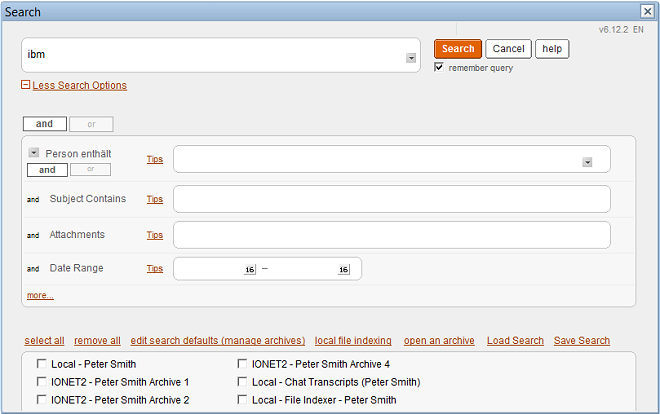
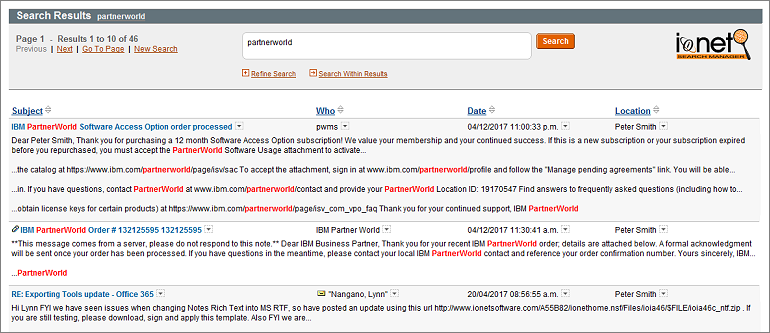
For example, a search for 'ibm +partner*' might show a result like this;


Opening the result will display all the search phrases highlighted, and also scroll to the first match found, no matter it's location in the document;


The downsides;

1. If you edit/save a document opened from the search results, you'll be prompted with a save conflict.
2. Editing the document means the LastModified/LastAccessed properties change, which may affect archiving and replication. 

It's a hack - but it's optional, and a tradeoff between providing a more useful search experience, and the two downsides mentioned above.

Sunday, 23 September 2012

The limitations of Notes Mail searching

Lotus Notes is great at many things, but the native search capability is not one of them.

A majority of Notes Mail users will have personal silos of information, most of it corporate, stacked up in their mail file and possibly also contained in several archive databases.

When they want to search that information, they have to know roughly where the target resides, i.e. their production mail or whatever archive, because there is no central index. That means opening each database manually and searching it individually.

Furthermore, the results of a Notes Mail search are quite poor - you get the same row-based information as a Notes View - so if you're searching on a common word, i.e. the name of a major client, you might get hundreds of search results. If all you see is basic summary information (Sender/Recipient, Date, Subject), how do you find the email you want?


The answer is you open each email and scroll through to see if it's the one you want. If you can't find it, you widen your search and start again. 

That's horribly inefficient, and means users can take a long time to achieve something as trivial as finding an email.

What Notes has long needed is a multi-database/file system personal search tool (think a Site Search for your mail, archives, local databases and local file system), where the search starts from Notes itself, and the results show you your search phrases in the context of the document. You can then perform only one search, scan documents from the result set via document-context information, and quickly find the target email.

As an example, if you were searching for an email you received last year, which mentioned something about a major client 'ACME' starting a project, you might search using a query like 'ACME and Project'. Using the result set, you'd then have to guess from the brief summary information provided which document it might be, and open each one to check the contents.

However if the result set showed the search query in the context of each document, then it's pretty simple to identify the email you want.


This is exactly what we've done with the FT Search Manager, and it makes finding information in mail (no matter it's location) much, much faster. Until IBM provide better search tools in Notes, solutions like this can save you a lot of time, and therefore money.